
17/11/2025
Original Article - https://www.timesofisrael.com/in-world-first-israeli-scientists-use-rna-based-gene-therapy-to-stop-als-deterioration/
Publication: The Times of Israel
In a groundbreaking study, researchers at Tel Aviv University, leading a large-scale international team of scientists, say they have identified an RNA molecule that can stop the nerve cell damage that causes paralysis in patients with amyotrophic lateral sclerosis, ALS.
Now, they hope to use the discovery to help patients with the fatal illness.
“When we added a specific RNA molecule to human cells and animal models for ALS, the nerve cells stopped degenerating and even regenerated,” said Prof. Eran Perlson from the Gray Faculty of Medical & Health Sciences and the Sagol School of Neuroscience at Tel Aviv University, speaking to The Times of Israel.
Their study, recently published in the peer-reviewed journal Nature Neuroscience, opens a new avenue for treating the disease.
“We wanted to get to the root of the matter of what causes ALS to enable the development of effective drugs for this incurable disease,” Perlson said. The team used mice that had been genetically modified to serve as a “biological stand-in” for the disease.
The research was led by Dr. Ariel Ionescu, Dr. Lior Ankol, and lab manager Tal Pery Gradus in collaboration with Dr. Amir Dori, Senior Neurologist and Head of the Neuromuscular Disease Unit at Sheba Medical Center. Additional participants included researchers from the Weizmann Institute of Science, Ben-Gurion University of the Negev, and research institutions in France, Turkey, and Italy.

About ALS
ALS, sometimes called Lou Gehrig’s disease, is a fatal neurodegenerative condition that affects motor neurons — the nerve cells that control muscle movement. Over time, the disease causes gradual paralysis of all muscles in the body.
Patients typically lose their ability to walk, speak, swallow, and breathe, often becoming completely paralyzed while their cognitive skills remain intact.
“Most patients die within three to five years of diagnosis, due to paralysis of the diaphragm muscles and respiratory failure,” said Perlson.
There are currently some 600 ALS patients in Israel, according to Efrat Carmi, CEO for IsrALS, the Israeli Research Association.
In ALS, the neuromuscular junctions, where nerve fibers meet muscle cells and transmit electrical signals from the brain to the muscles, are disrupted.
Perlson stated that the molecular mechanisms underlying this damage had remained unknown until now.
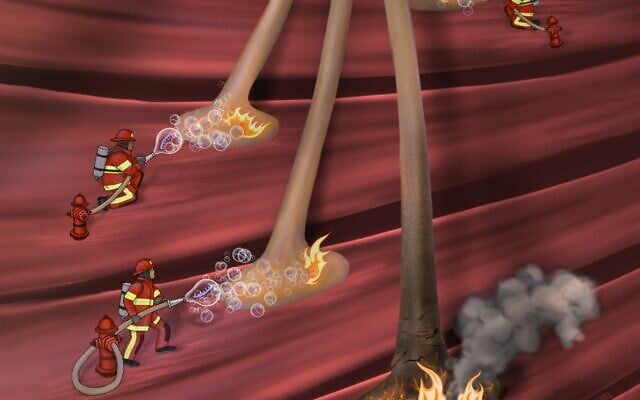
The microRNA that causes trouble in ALS patients
The current study continues research from Perlson’s lab about microRNAs, the small molecules that regulate the translation of proteins and play an important role in many other cellular processes.
In an earlier study, Perlson and his team found that a protein called TDP-43 formed toxic clusters at the tip of the nerve, where it meets the muscle.
In healthy bodies, the TDP-43 helps regulate how proteins are made in cells. But in ALS, it becomes unstable. To find out why this happens, the researchers studied tissues from ALS patients, mice that mimic having the disease, and human stem cell cultures.
Their experiments revealed that muscle cells produce tiny RNA molecules called microRNA-126.
The muscle cells then send them in tiny bubbles, called vesicles, across the small gap between nerve and muscle cells.
These microRNAs act like messengers that tell the nerve cells when to stop making TDP-43. Without the microRNA, TDP-43 continues to build up and becomes toxic.
“We discovered that in ALS, the muscle produces a smaller amount of microRNA-126,” said Ionescu. The decrease in this microRNA leads to an increase in the dangerous TDP-43.

The excessive TDP-43 then forms toxic clusters. These clumps attack the mitochondria, the essential molecules inside cells that turn food and oxygen into energy so the cell can work, move, and stay alive.
The damage is so great that it gradually destroys motor neurons, “leaving patients’ muscles paralyzed,” Ionescu said.
However, when the researchers added extra microRNA-126 to tissues from ALS patients and to mice with the disease, the process reversed.
Faculty of Medicine, Hebrew University of Jerusalem. (Courtesy)
Zevik Melamed, the principal investigator at the Laboratory of Molecular and Translational Neuroscience at Hebrew University of Jerusalem’s Faculty of Medicine, said the study “suggests that protecting communication between muscles and nerves might be just as important as targeting neurons directly.”
“This is a real shift in how we think about preventing paralysis in ALS,” Melamed, who was not involved in the study, told The Times of Israel in a written comment.
The study can be the basis for gene therapy for ALS, Perlson said.
“The next step is taking it to clinical trials,” he said.
