
19/11/2025
BGU researchers find that weight loss at midlife may temporarily heighten inflammation in the brain, raising new questions about its long-term effects.
Obesity is a leading global health challenge, and weight loss is widely promoted to reduce its associated risks. However, emerging evidence suggests that in midlife, weight loss may not always deliver the same health benefits as it does in younger adults—and, in some cases, might even affect brain health.
In a new study from Ben-Gurion University of the Negev (BGU), scientists compared the effects of diet-induced obesity and subsequent weight loss in young adult and mid-aged mice. Both age groups restored normal blood glucose regulation during weight loss, suggesting that metabolic benefits are preserved across ages. However, in mid-aged mice, weight loss unexpectedly aggravated inflammation in the hypothalamus—a brain region that regulates appetite, energy balance, and many other vital functions.
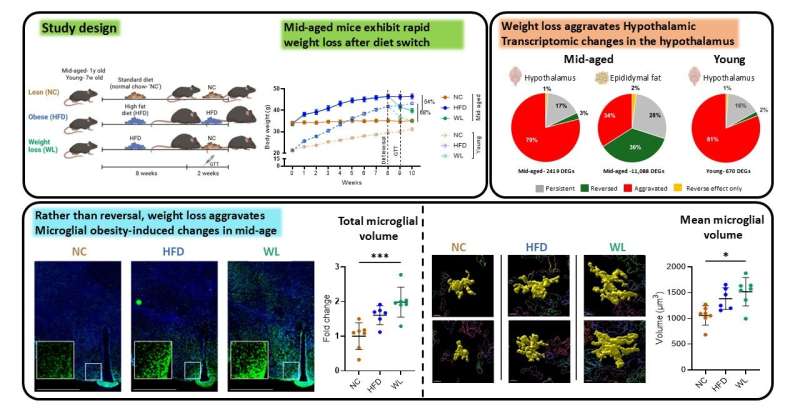
This neuroinflammation, observed both at the molecular level and through microscopic imaging of microglia (the brain’s immune cells), persisted for several weeks before subsiding. Although the consequences of this aggravated neuroinflammation remain uncertain and may even be required for the metabolic benefits to occur, these results raise concerns. Chronic or dysregulated inflammation in the brain has been linked to cognitive decline and neurodegenerative diseases such as Alzheimer’s. Therefore, these unexpected findings raise new questions about how weight loss at midlife may interact with brain health.
“Our findings show that losing weight in midlife is not a simple copy-and-paste of what works in young adulthood,” said Alon Zemer, an MD-PhD candidate and the first author of this paper. “Weight loss remains essential for restoring metabolic health in obesity, but we need to understand the impact of weight loss on the mid-age brain and ensure brain health is not compromised.”

Dr. Alexandra Tsitrina added: “Our study characterizes the body's adaptive response to weight loss through two complementary dimensions – molecular and structural. This high-end imaging by advanced microscopy and image analysis with advanced computational analysis enable detection of sensitive changes with potential health ramifications.”
The researchers emphasize the need for further studies to uncover the mechanisms behind this temporary but concerning neuroinflammatory response. Future research may help design strategies that preserve the benefits of weight loss while safeguarding brain health in midlife and beyond.
The study, titled, "Weight loss aggravates obesity‑induced hypothalamic inflammation in mid‑aged mice" was published last month in GeroScience and supported by an internal grant at BGU (with the Ilse Katz Institute of Nanoscale Science and Technology), and grants from the US-Israel Binational Science Foundation (Grant no. 2021083) and the Israel Science Foundation (Grant No. 194/24).
